
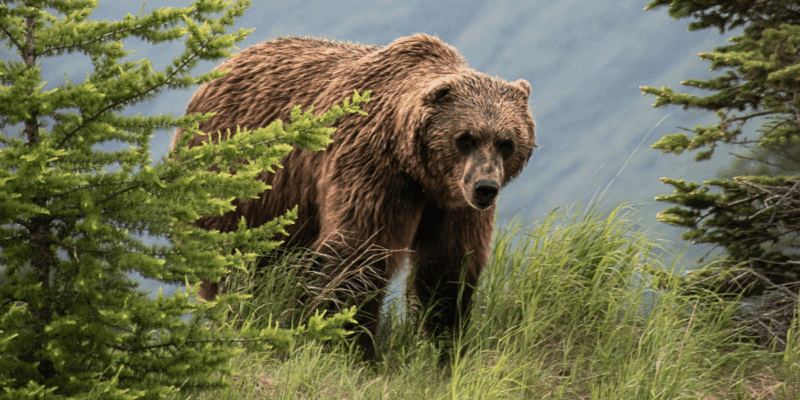
Grizzly Bear Remains On The Loose After Attack, With Authorities Now Seeking 3 Bears
A school group of fourth and fifth graders in British Columbia, Canada, were having lunch on a trail near the Bella Coola River when they were attacked by a grizzly bear.
This attack, which occurred in the afternoon of Thursday, November 20, saw 11 individuals injured, with the BBC noting that seven of them were treated at the scene when the Royal Canadian Mounted Police arrived.
Of the other four victims, three are children and the other is an adult who reportedly “got the whole brunt” of the attack. Two of the children were “seriously hurt,” while the other child was “critically injured” with the adult.
This school group was from Acwsalcta School, which is an independent indigenous school in the Nuxalk Nation in Bella Coola.
According to an update provided on Friday, November 21, by the British Columbia Conservation Officer Service (BCCSO), “Multiple teachers physically intervened, using bear spray and a bear banger, to drive the bear away.”
However, the BCCSO investigation, as of Saturday, November 22, now indicates there were three grizzly bears in the area during the attack (more on this update, below)…
One mother of a child who witnessed the incident told The Canadian Press that her 10-year-old son was “running for his life” and was so close to the animal that “he even felt its fur.”
Now, the bear remains at large, with the BCCSO conducting an armed search for the bear overnight and failing to locate it. However, the investigation indicates that “the offending bear may have been previously injured.”
In a statement released by the school board, the “extraordinary strength and compassion” exhibited by students, teachers, and first responders was commended. In response to the attack, the Acwsalcta School ensured all of its students were transported home by bus or SUV as a safety precaution in light of the bear still being at large.
“To our staff: thank you for your swift actions, calm leadership, and unwavering dedication to protecting and supporting our students,” the school board said.
Just after 1 p.m. EST on November 21, Inspector Kevin Van Damme, of the BCCOS, provided an update on the attack in a video statement, saying:
“We recognize this incident is distressing for the community. We are in close contact with the Nuxalk Nation as our investigation continues. We thank them for their collaborative efforts to ensure community awareness and shared safety information. Our thoughts are with the victims and their families, and we wish them a full and speedy recovery.”
The BCCOS continues to direct the community to avoid the forested area and river near 4 Mile. Residents are asked to remain indoors until further notice.
Watch BCCOS Inspector Kevin Van Damme’s update on the bear attack, here:
The Hunt For The Bear Expands To Search For 3 Grizzly Bears
“Based on investigative efforts to date, including witness accounts, two additional grizzly bears were seen in the area during the attack,” stated the British Columbia Conservation Officer Service on its Facebook page on Saturday, November 22.
In that post, the agency noted it has assigned more officers and resources to the search and investigation, including the use of one of the Royal Canadian Mounted Police’s drones, called a FLIR, that has thermal imaging capabilities.
Continuing, the BCCSO said:
“Trapping efforts to capture and assess all three bears are ongoing. The investigation includes the collection of any forensic evidence that can be used to identify bears involved.”
In this update, the BCCSO included a photo of a grizzly bear paw print being measured, which can be seen here:
“Teams of Conservation Officers rotated throughout the night to search for the female and two young bears,” wrote the BCCSO on Facebook on November 23.
This was the first public mentioning of the age disparity of the bears, implying the attacking grizzly bear may have been in the presence of its cubs.
Further, the BCCSO noted, “Any bears captured will be assessed, in consultation with wildlife biologists and the provincial wildlife veterinarian with the Ministry of Water, Land And Resource Stewardship, to determine next steps. Conservation Officers use a variety of tools, including forensically matching DNA evidence if possible, to confirm which bears are involved in attacks.”
As of Monday, November 24, the BCCSO reports that two grizzly bears “have been safely captured,” but it is not clear yet if either bear was involved in the attack.
“Conservation Officers have assessed the bear, including comparing attack scene evidence with evidence analyzed from the captured bear,” wrote the BCCSO on Facebook after it captured its first bear in the Bella Coola area. “Evidence is not conclusive that the captured bear was involved in the attack.”
The BCCSO added, “As a result, the bear will be fitted with a GPS collar and relocated in coordination with wildlife biologists and the provincial wildlife veterinarian with the Ministry of Water, Land and Resource Stewardship.”
In light of the bears’ involvement in the attack being inconclusive, the BCCSO is still looking for three grizzly bears.
This attack comes just over a month after two hikers were attacked by a grizzly bear protecting its cubs on Farm Cabin Trail near the McGregor mountain area just northeast of Prince George, British Columbia.
CBS News reported that one of the hikers “died a few weeks later due to complications.”
The bear involved in that October 12 attack “was also found dead.”
RELATED: 2 Hikers “Seriously Injured” By Grizzly Bear Defending Her Cubs